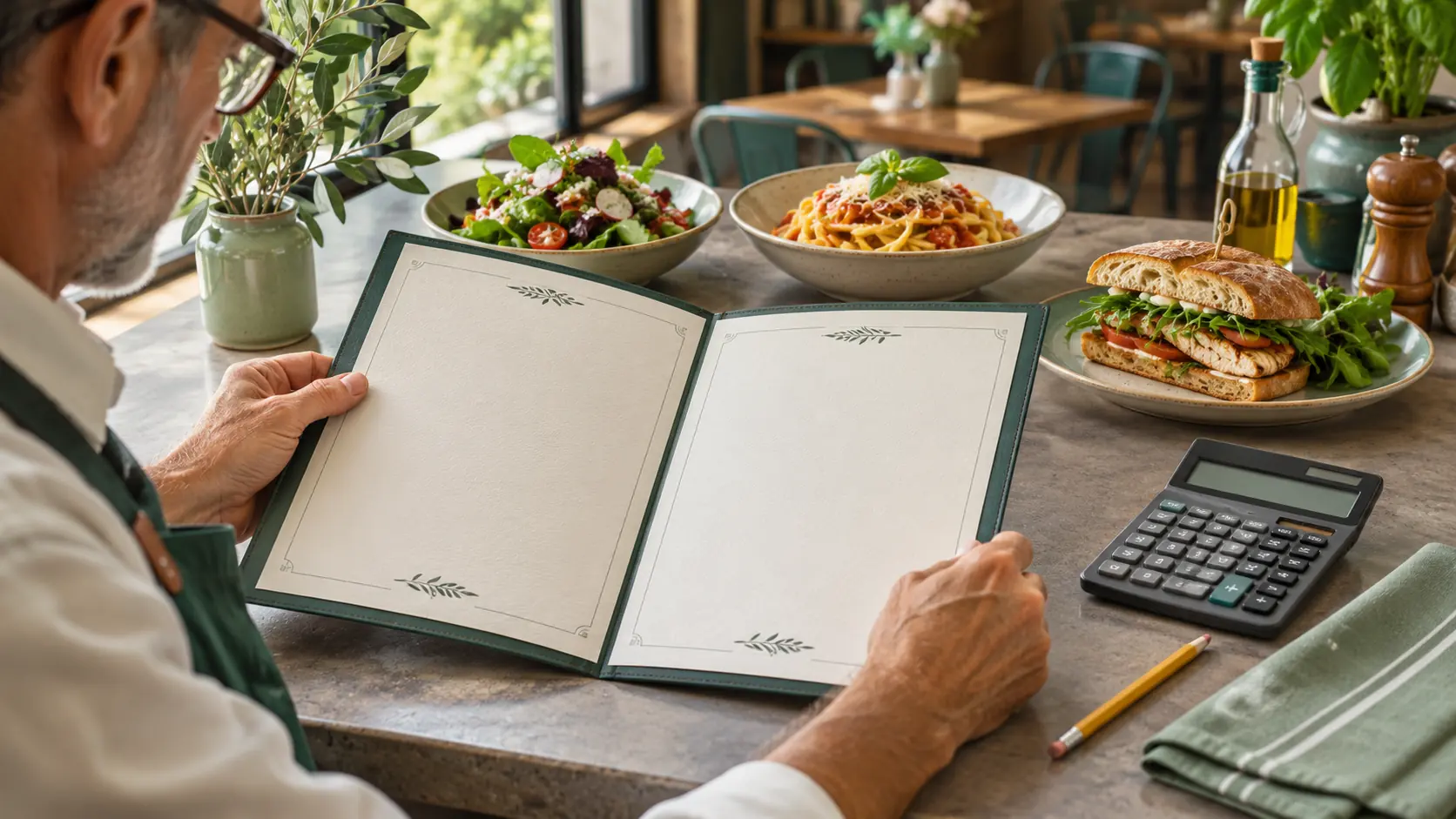
The same sandwich can be profitable at one restaurant and a money loser at another. Ingredient prices matter, but so do portion size, labor, rent, packaging, delivery fees, and how guests respond to the price. Restaurant menu pricing works best when you calculate a defensible starting point, then test that number against your actual operation.
Quick answer: Measure the ingredient cost of one standardized serving. Divide it by a proposed food cost percentage expressed as a decimal to estimate a starting menu price. Then check whether that price covers your other costs, fits your customers, and produces an acceptable contribution toward operating expenses and profit. No single percentage guarantees profitability.
At a Glance
- Cost each ingredient in the quantity actually used.
- Confirm the edible yield and standardized serving size.
- Choose a provisional food cost target based on your business.
- Calculate a starting selling price.
- Test labor, overhead, fees, sales mix, and customer expectations.
- Monitor actual sales and costs and revise the price when needed.
What Goes Into a Restaurant Menu Price?
An item needs to contribute more than its ingredient bill. A reliable costing worksheet keeps different expenses visible instead of treating every expense as “food cost.”
| Input | Why it matters |
|---|---|
| Ingredients actually used | Direct food cost of the portion |
| Trim, spoilage, and cooking yield | Change the amount purchased to produce one sellable portion |
| Direct preparation labor | May change significantly between a simple side and a labor-intensive entrée |
| Packaging and delivery fees | Can make takeout economics different from dine-in economics |
| Occupancy, utilities, and other overhead | Must be covered across the menu and sales volume |
| Taxes and payment-processing charges | Depend on location, channel, and how the transaction is structured |
| Guest demand and competition | Influence whether a mathematically calculated price is commercially workable |
Ingredient cost as a share of selling price is one useful ratio. The operating decision also depends on what remains after other expenses.
Step 1: Calculate Ingredient Cost per Serving
Start with a standardized recipe: quantities, supplier purchase units, usable yields, and the number of equivalent portions produced. Convert each package price into a price per unit before pricing the quantity used.
Imagine a soup recipe uses half of an $8 container of stock. The stock costs $4 for that batch, not $8, assuming the unused half can be stored and used. If a batch contains $48 of ingredients and produces 12 comparable servings, its ingredient cost is $48 ÷ 12 = $4.00 per serving.
For products with trimming or cooking losses, calculate from a consistent purchased-weight or edible-weight basis; do not count the same loss twice. Recheck actual portions during service. A recipe that produces only 10 servings instead of 12 now costs $4.80 per serving, even though the batch ingredients have not changed.
Build a portion-level ingredient cost sheet
Here is one way to document the sandwich used in the examples below. Purchase-unit costs are allocated only to the quantities needed for one serving.
| Ingredient | Quantity purchased/used for one sandwich | Purchase-unit cost | Extended ingredient cost |
|---|---|---|---|
| Bread | 2 slices | $0.30/slice | $0.60 |
| Chicken | 5 oz raw, yielding 4 oz cooked | $0.36/raw oz | $1.80 |
| Lettuce | 1 oz usable | $0.25/usable oz | $0.25 |
| Sauce | 1 fl oz | $0.30/fl oz | $0.30 |
| Tomato | 1 oz usable | $0.20/usable oz | $0.20 |
| Total | One sandwich | $3.15 |
The chicken line assumes an 80% cooked yield: 5 oz purchased × 0.80 = 4 oz served. Its cost is still 5 × $0.36 = $1.80, or $0.45 per cooked ounce. This is a costing assumption for the example, not a typical yield claim. For lettuce or tomatoes bought with stems or trim, either price the purchased quantity needed to obtain one usable ounce or adjust the purchased-unit rate for yield—never both. Keep weight ounces separate from fluid ounces: the sauce is measured by volume here.
Step 2: Choose a Target Food Cost Percentage
A food cost percentage compares ingredient cost with selling price for a menu item:
Food cost percentage = ingredient cost per serving ÷ selling price × 100.
To check the ingredient-cost and target-percentage calculation, open the FoodFormula Menu Pricing Calculator. Use your own measured inputs and evaluate the suggested starting price against labor, overhead, and customer demand before making a menu decision.
The target you choose should reflect your concept, service model, labor requirements, expected demand, and other expenses. A proposed 30% target in the example below is hypothetical, not an industry standard or recommendation for every restaurant.
Ask what happens if a dish requires extensive preparation, a costly delivery channel, or frequent discounting. An item with a lower ingredient percentage is not automatically more profitable once the rest of its expenses are considered.
Step 3: Calculate a Starting Menu Price
Rearrange the food cost equation:
Starting price = ingredient cost per serving ÷ target food cost rate.
Use a decimal rate: 30% becomes 0.30. For the hypothetical $4.00 serving above:
$4.00 ÷ 0.30 = $13.333…, or $13.33 when displayed to the nearest cent.
At $13.33, its ingredient percentage is about 30.01% after rounding. At $13.50, it would be about 29.63%. The formula offers a starting point, before you assess labor, fees, and demand.
Four Restaurant Menu Pricing Methods Compared
Different methods answer different questions. Use the same clearly defined cost basis when comparing options; none substitutes for checking the final price against customer demand.
| Method | Basic approach | Best use | Main limitation |
|---|---|---|---|
| Food Cost Percentage Pricing | Divide ingredient cost per serving by a target food cost rate | Find a quick cost-based starting price | Omits labor and other operating costs from the calculation |
| Contribution Margin Pricing | Set a price that leaves a chosen dollar contribution after specified variable costs | Compare the dollars different dishes contribute | A desired contribution still needs a sales-volume and overhead test |
| Prime Cost Pricing | Evaluate ingredients plus direct labor against sales or a planned prime-cost ratio | Examine labor-intensive dishes and staffing effects | Labor allocation and prime-cost targets depend on the operation |
| Factor/Markup Pricing | Multiply a defined cost base by a factor, or add a percentage markup to cost | Make simple, repeatable preliminary quotes | A fixed factor can hide differences in labor, fees, and demand |
For the $4.00 ingredient-cost dish, a proposed 30% food cost rate produces $13.33. A factor of 3 on ingredients produces $12.00. A desired $9.00 contribution after those ingredients alone would suggest $13.00—but the result changes if other variable costs are included. For a prime-cost illustration, suppose allocated direct labor is $3.00 per dish and the operator tests a 55% prime-cost rate: ($4.00 + $3.00) ÷ 0.55 = $12.73 after rounding. These are alternative tests under different assumptions, not four equivalent profitability measures or recommended industry targets.
Step 4: Check Labor, Overhead, and Profitability
Suppose you sell the dish at $13.50. Deduct $4.00 of ingredients and its contribution before other expenses is $9.50. That amount still needs to cover appropriate labor, occupancy, utilities, fees, and other costs; it is not $9.50 of net profit.
To test the price, estimate the cost of preparing and serving the item. Review the contribution per sale alongside your projected sales volume and the menu mix. A low-volume, high-contribution item may help less overall than a frequently ordered item with a smaller contribution. Also check whether customers see comparable value at the proposed price.
Dine-in versus delivery: the same price is not the same contribution
Using the $10.50 sandwich with $3.15 in ingredients, compare a dine-in sale with an app order at the same listed price. Suppose the platform takes a 25% commission, rounded to cents for the individual order.
| Per sandwich | Dine-in | Delivery-platform order |
|---|---|---|
| Selling price | $10.50 | $10.50 |
| Ingredient cost | −$3.15 | −$3.15 |
| Platform commission | $0.00 | −$2.63 |
| Contribution remaining before other expenses | $7.35 | $4.72 |
The commission is $10.50 × 0.25 = $2.625, rounded to $2.63. The delivery order leaves $2.63 less to cover packaging, labor, occupancy, payment charges, promotions, and profit. This simplified comparison excludes those additional expenses on both channels. Actual platform contracts may use different fee bases, taxes, rounding, and promotional charges; check the agreement and your transaction records before setting channel prices.
Step 5: Use a Pricing Worksheet and Check Your Assumptions
Record the recipe version, purchase-price date, ingredient quantities, usable yield, serving size, target rate, calculated base price, and final tested price. A menu pricing calculator can simplify the starting-price arithmetic, but it cannot substitute for the assumptions behind the inputs or the broader profitability review.
Worked Examples: Sandwich, Salad, and Pasta
All numbers below are illustrative, not observed restaurant prices or recommended targets.
| Item | Ingredient cost per serving | Hypothetical target | Calculated starting price |
|---|---|---|---|
| Sandwich | $3.15 | 30% | $10.50 |
| Salad | $2.70 | 27% | $10.00 |
| Pasta | $4.20 | 35% | $12.00 |
The formulas are $3.15 ÷ 0.30, $2.70 ÷ 0.27, and $4.20 ÷ 0.35. Their contributions after ingredients—but before other expenses—are $7.35, $7.30, and $7.80 respectively.
This table also illustrates why target percentages can differ across dishes. The right decision depends on how each item fits the operation, not on forcing the same target onto every plate.
A Quick Introduction to Menu Engineering
Price is only half the menu decision. Contribution margin shows how much a dish leaves after the variable costs you have chosen to include. Menu mix is each item's share of orders within a defined period or category. Together, contribution and sales popularity help you identify what to investigate:
- Stars: high contribution and high popularity. Protect quality and availability; monitor whether cost increases erode their value.
- Plowhorses: popular but lower-contribution items. Test portions, sourcing, preparation, or modest price adjustments before making changes that could alienate regular customers.
- Puzzles: high contribution but relatively low popularity. Examine placement, naming, server recommendations, and whether customers understand the item.
- Dogs: lower contribution and lower popularity. Consider whether an item has a strategic role before simplifying or replacing it.
Those labels require a consistent comparison set, sales period, and definition of contribution. They are prompts for decisions, not automatic orders to raise prices or remove dishes. A focused menu engineering review belongs in its own analysis; start here by tracking item sales counts alongside item-level contributions.
Common Menu Pricing Mistakes
Using a package's full price for a fraction consumed. Convert purchase units into actual used quantities. Otherwise, the dish may appear more expensive than it is.
Ignoring edible yield and changing portions. Standardize serving size and monitor trim and production losses; a larger serving alters both cost and guest experience.
Confusing markup with margin. Markup divides the price–cost difference by cost. Gross margin divides a suitably defined gross profit by revenue. Their percentages are not interchangeable, and ingredient-only “margin” is not necessarily accounting gross margin.
Using a target food percentage as a guarantee. The calculation excludes major operating costs. Review them separately and do not assume a $13.33 calculated price is feasible in your market.
Applying one dine-in price to every channel without checking fees. Delivery commissions, packaging, promotions, and taxes can change the economics. Evaluate each channel separately.
When Should You Review Menu Prices?
Check prices when supplier invoices rise, usable yield falls, portions drift from the standard, hourly labor needs change, discounting grows, delivery fees change, or an item's sales volume shifts. Also investigate a recurring gap between theoretical recipe cost and actual kitchen usage: it may point to waste or inconsistent portioning rather than an inadequate price. A regular worksheet review can identify early changes; choose the cadence based on purchase volatility and sales volume, not a universal percentage threshold. Record the date, recipe version, channel, and reason for each change. When customer demand weakens after an increase, reassess the whole offer instead of automatically raising the price again.
Frequently Asked Questions
Is food cost the same as markup?
No. Food cost percentage expresses ingredient cost as a share of the selling price. Markup expresses the difference between price and a defined cost basis as a share of that cost basis. Neither alone measures net profit.
Should I round the calculated price?
You can test practical prices, but recalculate the resulting percentage after rounding. For example, $4.00 in ingredients at $13.50 is about 29.63%, not exactly 30%.
Do delivery fees belong in the food cost percentage?
They generally are not ingredient costs. Evaluate them separately as channel expenses, alongside packaging, payment fees, and promotions, before judging profitability.
What if my actual portion is larger than the recipe standard?
Recalculate the ingredient cost with the actual amount used and review whether the standardized recipe, kitchen practice, or selling price needs adjustment.
Put the Numbers Into a Decision
Restaurant menu pricing is a cycle, not a one-time equation: cost the plate, choose and test a starting price, monitor what actually sells, and revise when the evidence changes. A transparent worksheet makes those decisions repeatable—and helps the whole team understand why a price changed.